

We’ve all probably heard the definition of “Airworthiness” under 3.5: i.e., “the aircraft conforms to its type design and is in a condition for safe operation.” However, in terms of an airworthiness certification context, “conforms to its type design” ACTUALLY means more like, "The aircraft matches all approved data that legally defines how this aircraft is allowed to exist." ("Definition #2")
Airworthy (Definition #2): means the aircraft matches all approved data that legally defines how this aircraft is allowed to exist.
What exactly is "that data that legally defines how an aircraft is allowed to exist"? In a nutshell, the “approved data set” includes the original TC type design (TCDS), all applicable STCs, previously approved major alterations (including field approvals) and any approved deviations or limitations.
This matches what we know from the Witkowski Interpretation, which states: “While most mechanical, electrical, or structural unairworthy conditions would probably implicate issues with the type design, our answer applies to the broader concept of airworthiness that includes compliance with the type certificate, including supplemental type certificates, and airworthiness directives.”
“While most mechanical, electrical, or structural unairworthy conditions would probably implicate issues with the type design, our answer applies to the broader concept of airworthiness that includes compliance with the type certificate, including supplemental type certificates, and airworthiness directives.”
Note the term, “broader concept”. Depending on the context used, we’ve seen “Type Design” as having two legitimate meanings: certification (strict) vs. operational conformity (broad):
It is also worth noting that the Witkowski interpretation did NOT mention “field approvals” under its concept of “airworthiness”. A field approval approves a major alteration for one aircraft and approves that data specific to that configuration for that aircraft serial number. It does NOT amend the TC, create an STC, or create an approved type design. However, the specific alteration becomes part of the approved configuration baseline for that N-number.
"A field approval does NOT amend the TC, create an STC, or create an approved type design. However, the specific alteration becomes part of the approved configuration baseline for that N-number."
So In essence, you could say, “For a specific aircraft, conformity to type design means conformity to the TC as modified by applicable STCs and approved major alterations, including field approvals.”
This is consistent with our conversations with FAA engineers and DARs. “For a specific aircraft, conformity to type design means conformity to the TC as modified by applicable STCs and approved major alterations, including field approvals.”
“For a specific aircraft, conformity to type design means conformity to the TC as modified by applicable STCs and approved major alterations, including field approvals.”
In summary, for Part 21, only TCs and STCs define type design. However, for a specific aircraft, “conforms to its type design” functionally means conformity to the TC baseline as modified by all applicable STCs and approved alterations, including field approvals.
Here is a table outlining major approved and accepted data:
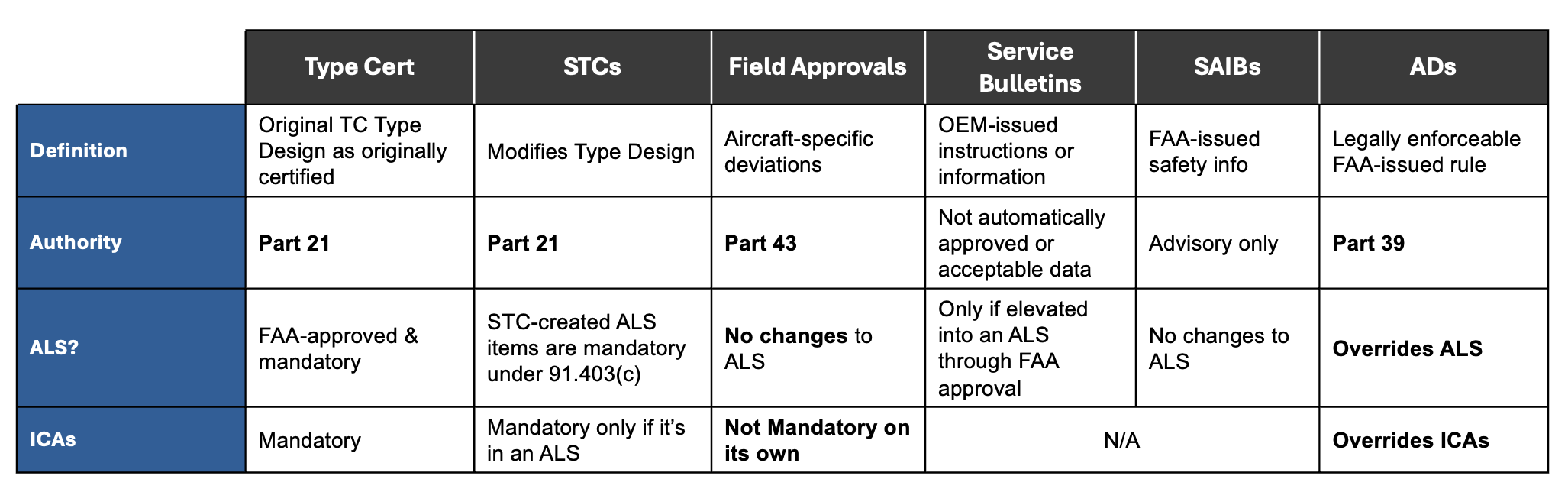
One area of great contention today is how to stay compliant with an ICA on a 337 / field approval. Legally, a Form 337 alteration / field approval that includes an ICA does NOT make those ICA mandatory by themselves because:
“Hold on a second!” is probably what you are thinking…“Doesn’t an aircraft have to be maintained per its approved data?” Of course it does! You cannot ignore airworthiness, violate the ALS, or avoid complying with ADs. All it means is that either you use the ICA OR propose an alternative using approved data (or approved maintenance program).
You cannot ignore airworthiness, violate the ALS, or avoid complying with ADs. All it means is that either you use the ICA OR propose an alternative using approved data (or approved maintenance program).
As we heard someone the other day say, “Think of ICAs as a shortcut, but not the only path to airworthiness.”
--
If you made it this far, thanks for reading.

