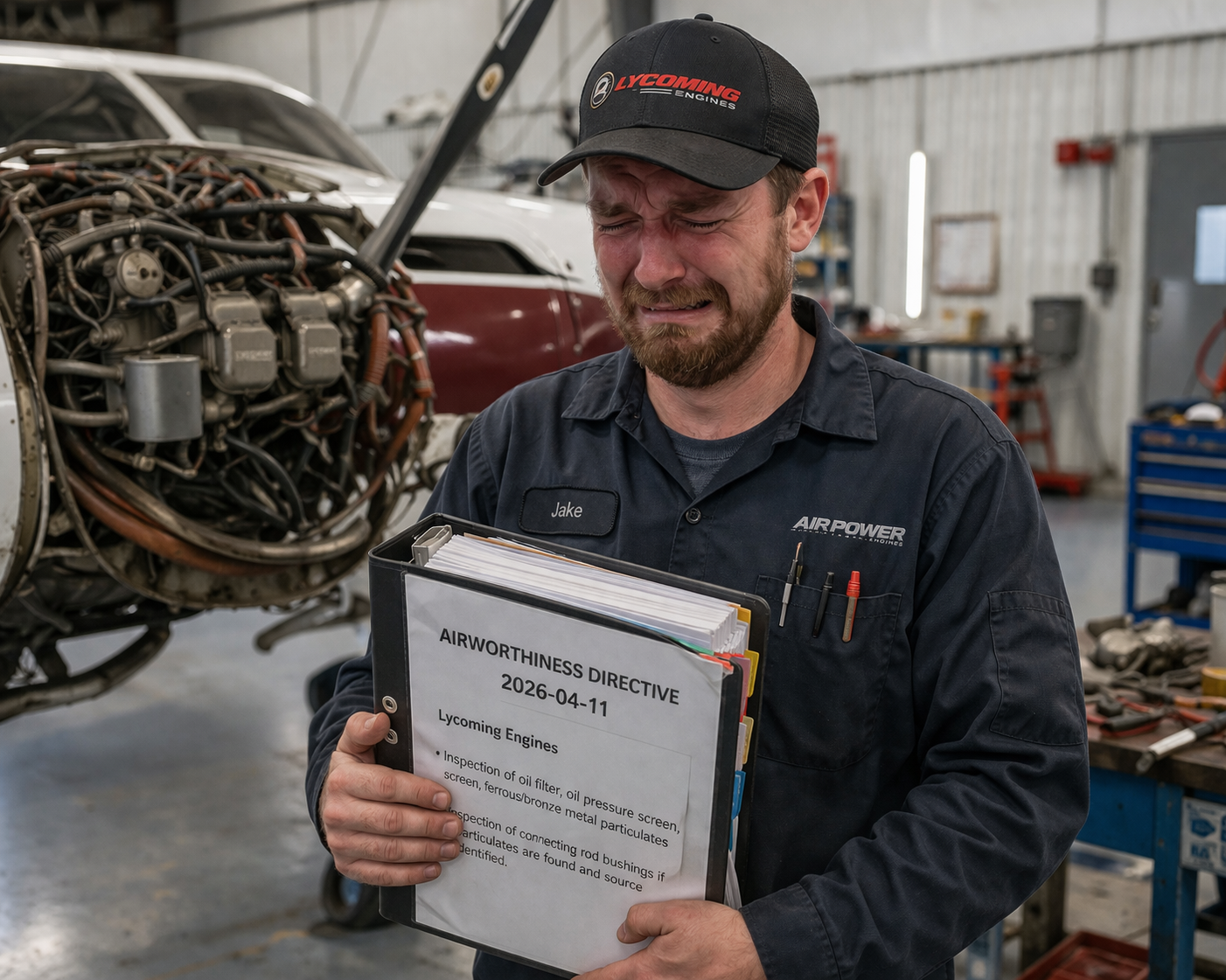
Last month, the Connecting Rod Bushing AD for Lycoming engines (24-21-02) was superseded with an updated AD (2026-04-11), broadening the scope of the prior AD to include new part #'s and new date ranges. The new AD now affects an estimated 45,000 aircraft engines—up from the prior 16,000 estimated in the superseded AD—which is bound to stress out aircraft owners, mechanics and FAA inspectors everywhere, as the AD was already on our shortlist of "Usual Suspects", ADs that are often missed, omitted, or misunderstood.
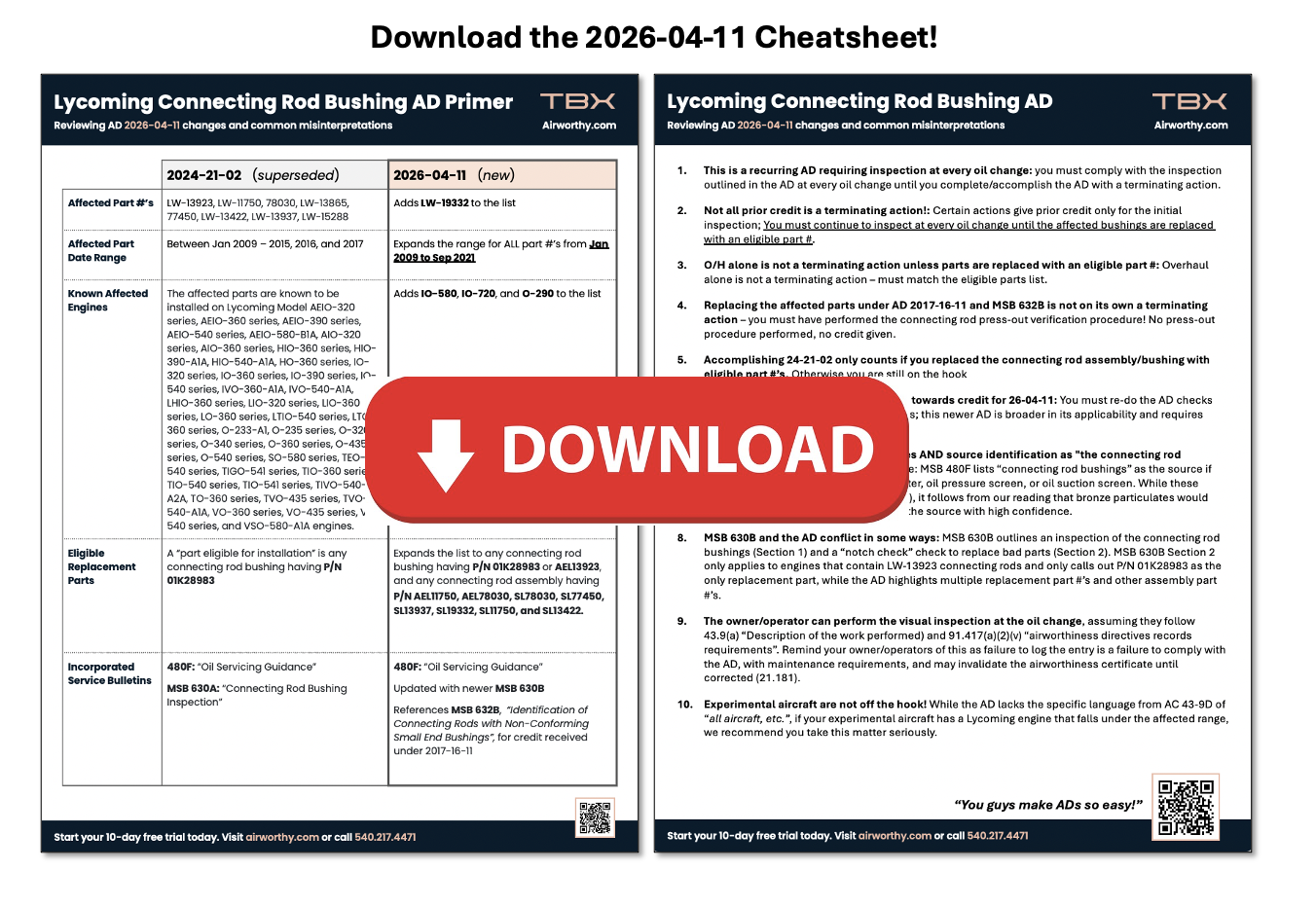
As such, we thought it would be helpful to outline the changes to the AD and clarify sources of confusion, first a cheatsheet (downloadable here), and then here in this piece.
First, let's walk through a summary of the changes:
Expanded Date Range: the date range has been expanded from 2009 - 2015, 2016, and 2017 to now encompass Jan 2009 - Sep 2021.
New Affected Engines: the AD explicitly calls out three new Lycoming variants known to be affected: IO-580, IO-720, and O-290
New Assembly Part #: the AD adds a new part # to the list of affected part numbers: LW-19332
New Eligible Replacement Parts: while the prior AD only allowed one eligible part # for replacement (P/N 01K28983), the new AD now expands the eligible replacement part list to any connecting rod bushing having P/N 01K28983 or AEL13923, and any connecting rod assembly having P/N AEL11750, AEL78030, SL78030,SL77450,SL13937, SL19332, SL11750, and SL13422.
New Incorporated Service Bulletins: while 480F still applies, 630A was since updated to 630B.
Credit for prior actions: partial and full credit options are outlined, and can be confusing, given that this is a recurring AD at every oil change (not just annual or 100 hour inspection) - operators and maintainers need to be aware of what they are signing off.
Now, let's breakdown a short list of the top 10 potential areas for confusion, helping folks avoid misinterpreting the language and the intent of the AD.
This is a recurring AD requiring inspection at every oil change: you must comply with the inspection outlined in the AD at every oil change until you complete/accomplish the AD with a terminating action. As we wrote in our Mythbusters piece, some ADs are required to be complied with outside of annual inspections and/or maintenance.
Not all prior credit is a terminating action! Certain actions, such as compliance with Lycoming MSB 480F and MSB 630A, give prior credit ONLY for the initial inspection; You must continue to inspect at every oil change until the affected bushings are replaced with an eligible part #.
O/H alone is not a terminating action unless parts are replaced with an eligible part #: Overhaul alone is not a terminating action – the new parts must match the eligible parts list!
Replacing the affected parts under AD 2017-16-11 and MSB 632B is not on its own a terminating action: you must have performed the connecting rod press-out verification procedure as outlined in MSB 632B. No press out verification, no credit given.
Accomplishing 24-21-02 only counts if you replaced the connecting rod assembly/bushing with eligible part #'s - otherwise you are still on the hook
"N/A" entries for 24-2102 do not count towards credit for 26-04-11! You must re-do the AD checks against the part numbers and date ranges; this newer AD is broader in its applicability and requires further investigation
The AD requires any bronze particulates AND source identification as "the connecting rod bushings" to trigger an inspection. Note: MSB 480F lists “connecting rod bushings” as the source if any bronze “chips” are found in the oil filter, oil pressure screen, or oil suction screen. While these tables are interpretive (and not definitive), it follows from our reading that bronze particulates would point to the connecting rod bushings as the source with high confidence.
MSB 630B and the AD conflict in some ways: MSB 630B outlines an inspection of the connecting rod bushings (Section 1) and a “notch check” check to replace bad parts (Section 2). MSB 630B Section 2 only applies to engines that contain LW-13923 connecting rods and only calls out P/N 01K28983 as the only replacement part, while the AD highlights multiple replacement part #’s and other assembly part #’s.
The owner/operator can perform the visual inspection at the oil change. Because AD compliance is maintenance, owners must follow rules for making an entry, i.e., 43.9(a) “Maintenance Record Entries") and 91.417(a)(2)(v) “the current status of airworthiness directives”. Remind your owner/operators of this as failure to log the entry is a failure to comply with the AD, with maintenance requirements, and may invalidate the airworthiness certificate until corrected (21.181).
Experimental aircraft are not off the hook! While the AD lacks the specific language from AC 43-9D of “all aircraft, etc.”, if your experimental aircraft has a Lycoming engine that falls under the affected range, we recommend you take this matter seriously.
For a printable version of these, download the cheatsheet here.
If you are interested in how our AD compliance software can help you save time, reduce risk, and create professional looking reports for your aircraft fleet or customers, sign up for our 10-day free trial here.