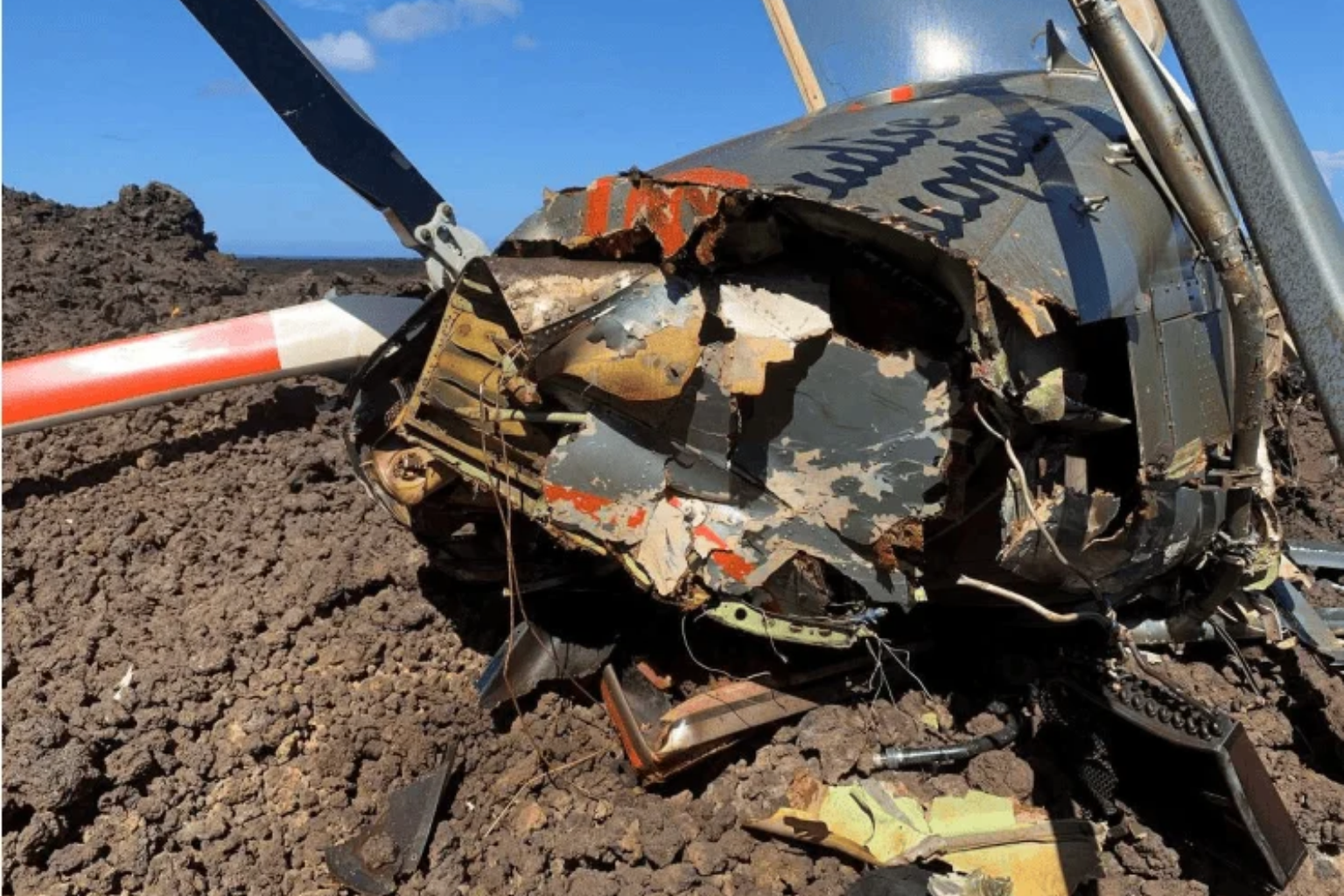

On June 8, 2022, a Bell 407 (N402SH) was on its fourth flight of the day, a Part 135 sunset tour near Ka Lae (South Point), Hawaii. The pilot had found no discrepancies on the walk-arounds, and the first 35 minutes were normal. Then, while cruising at 1,500 ft agl and 130 knots, the helicopter "made sudden, violent and uncommanded yaw and pitch changes," according to the pilot's report to the NTSB. It "took all of the pilot's strength" to try to control it. The pilot made two Mayday calls and told the passengers to brace for impact. The helicopter hit a lava field; three occupants were seriously injured and three had minor injuries.
The Story: The tailboom had separated in flight and was found about 762 ft from the main wreckage. The upper-left attachment bolt, which carries the highest tension load of the four attachment points, had "fractured and migrated out." Its load shifted to the remaining fittings. Fatigue cracks developed in the lower-left fitting, and the remaining attachments eventually failed in overload.
The parts met spec. The NTSB found sealant, and a small gap, between the upper-left longeron and the aft fuselage bulkhead. It said the gap was "likely introduced" during field replacement of those parts under Bell technical bulletins, about 8,050 hours before the accident. The NTSB determined the probable cause was "abnormal loading and fracture of the upper-left tail boom attachment bolt due to a gap between the upper-left longeron and aft fuselage bulkhead." The finding had an unexpected connection to another longstanding Bell 407 issue. That longeron, P/N 206-031-314-237B, had a history of its own: installed with three external strap doublers, it was the terminating action for upper-left longeron cracking under AD 2015-05-04. The NPRM would now prohibit installing it as a replacement.
N402SH wasn't the first warning. In December 2019, a 300-hour torque check on another 407 (S/N 53563) found its upper-left tailboom bolt fractured in two. That helicopter also had a field-installed -237B upper-left longeron, put in in October 2017. The operator reported "a gap between the aft fuselage bulkhead and the upper-left longeron." Bell reported it as the only previously known fractured tailboom attachment bolt.
Bell issued ASB 407-22-128, Transport Canada issued AD CF-2022-68, and the FAA followed with AD 2022-27-08, effective January 12, 2023. It required a one-time torque inspection (repeated after each hour, up to 5 hours, until torque stabilized) and a structural check within 25 hours or 30 days. The NTSB urged recurring inspections at intervals far shorter than 300 hours. In its final report, the Board noted that neither the FAA nor Transport Canada AD required any follow-on inspections after the initial compliance actions.
More broken upper-left bolts followed. In February 2024, Bell issued ASB 407-24-134 after another fracture on a helicopter with a field-replaced longeron. Transport Canada's CF-2025-59 (November 2025) cited "two additional reports of broken upper-left tailboom attachment bolts." Bell identified "improper manufacturing or improper installation of the upper left longeron assembly" as possible causes. On July 15, 2026, the FAA proposed superseding AD 2022-27-08 (Docket FAA-2026-7220). Comments closed August 31; no final rule has been issued yet.
Field Notes:
Today (AD 2022-27-08): one-time torque inspection of all four attachment nuts, a sealant and structure inspection, and a report to Bell within 10 days. It covers 839 U.S. 407s in specified serial number ranges.
Coming (NPRM): all Model 407s, an estimated 950 U.S. helicopters.
Why It Matters: N402SH didn't come apart because of a bad part; the longerons met drawing requirements. It came apart because a small gap at the upper-left joint likely changed how the upper-left bolt was loaded, and the last 300-hour torque check, only 114 hours earlier, found nothing wrong. The NPRM turns the NTSB's clue, sealant at the upper-left longeron joint that signaled a gap, into a required inspection step, and adds recurring gap checks at that joint until the tailboom-off inspection is done. For many 407s, the first job is in the logbooks: find out whether that upper-left longeron was ever replaced, and schedule the tailboom removal for your next downtime.
Sources: FAA AD 2022-27-08 (Amendment 39-22293); FAA NPRM, Docket FAA-2026-7220 (July 15, 2026); Transport Canada AD CF-2022-68 and CF-2025-59; Bell ASB 407-22-128 and ASB 407-24-134 Rev A; FAA AD 2015-05-04; NTSB final report ANC22FA041 (January 2024); NTSB Form 6120.1 pilot report; NTSB Aviation Investigation Report AIR-22-10 (December 1, 2022); NTSB Airworthiness Group Chair's Factual Report, ANC22FA041.
Need the complete AD? Download the complete AD here.
Research thousands of ADs in seconds. Start your free 10-day TBX trial today!


