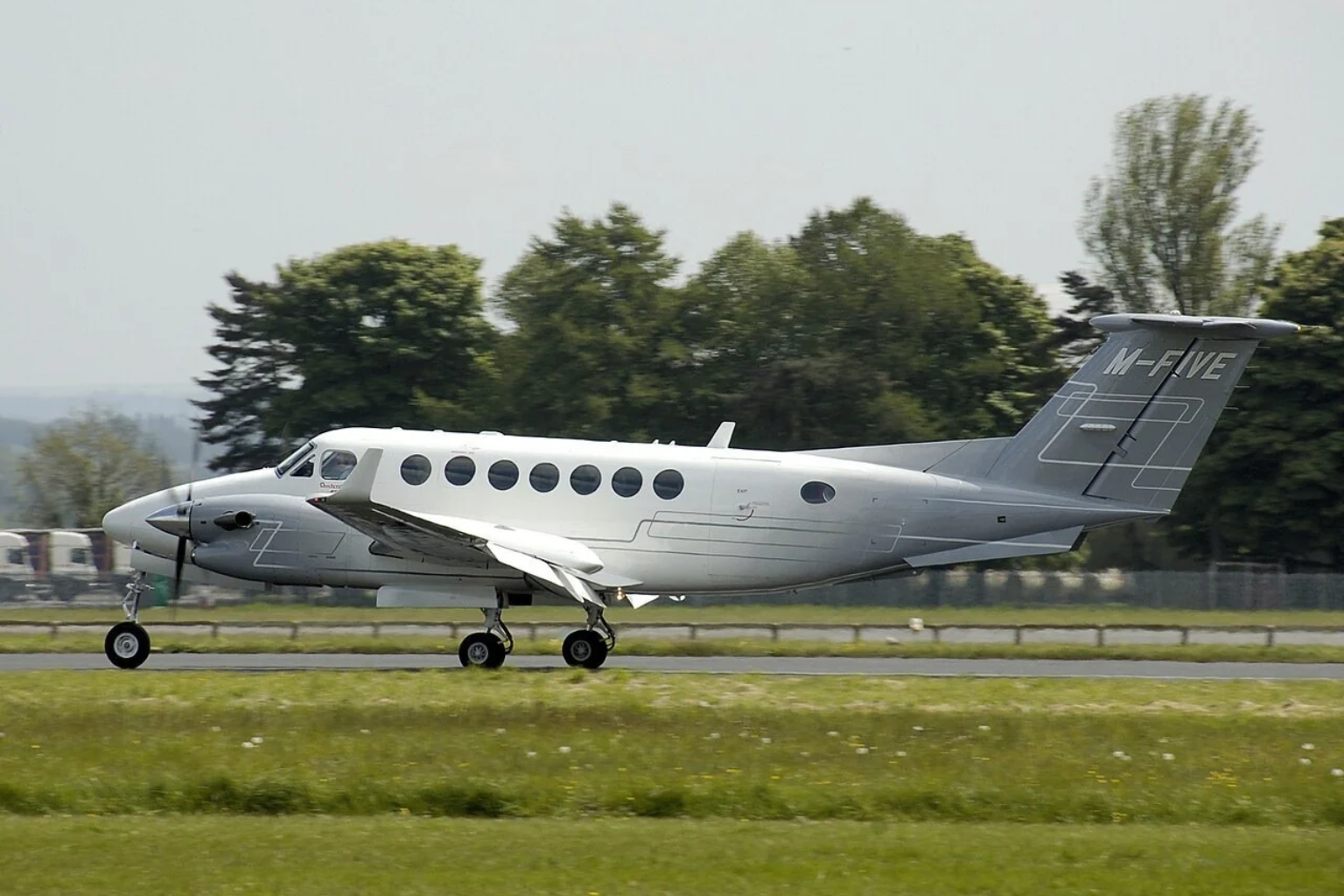

The airworthiness limitations didn’t separate heavyweight King Airs from standard ones, and the FAA says the difference in mission profiles matters. Textron notified the FAA that the wing inspection intervals in its Airworthiness Limitations Manual (ALM) for heavyweight King Air B300 and B300C airplanes were incorrect. Textron revised its structural inspection and repair manual, introducing what the FAA calls “more restrictive inspection intervals,” along with the ALM. But what the AD writes into the airworthiness limitations is a table of component replacement times, as short as 2,500 hours for the wing attach angles on early airframes. Citing the risk of undetected wing cracks, the FAA adopted the resulting Airworthiness Directive without prior notice or public comment, leaving high-time airframes as few as 25 hours time-in-service to comply.
The Story: The standard B300 and B300C are certified at a 15,000-lb maximum takeoff weight (MTOW); Kits 130-4014 (with extended-range tanks) and 130-4030 (without) raise it to 16,500 lb. According to the FAA, Textron reported that the ALM “contained incorrect wing inspection intervals for airplanes that are certified to or operating at a 16,500 pound (lb.) maximum takeoff weight.” Textron has since revised its Structural Inspection and Repair Manual (SIRM) and ALM to separate the wing inspection criteria for 15,000-lb and 16,500-lb airplanes.
Textron issued Mandatory Service Letter MTL-57-04 in February 2025. Seventeen months later, the FAA published AD 2026-15-05 on July 24, 2026 (effective August 10). The agency bypassed typical notice-and-comment procedures, stating:
“Current FAA data indicate that a number of airplanes are past the revised inspection intervals specified in this AD. Cracks in the wing spar or wing supporting structure could result in reduced structural integrity and consequent wing separation from the fuselage in flight.”
Pushback came from another federal agency. In a docket comment posted August 3, U.S. Customs and Border Protection (CBP) told the FAA that “Textron currently does not have the spar cold work kits available in sufficient quantities to meet operator demand.” CBP asked for relief from the compliance frequencies, suggesting “a preliminary inspection of the critical areas as an interim measure to extend the compliance interval,” so the agency could “continue meeting its mission requirements.” Comments closed September 8; the FAA says it “may amend this final rule” in response.
Field Notes
Who’s affected: The AD applies to B300 and B300C airplanes identified in MTL-57-04 Revision 1, including those with Kits 130-4402, 130-4030, or 130-4014 installed. The FAA estimates 113 U.S.-registered airplanes are affected. Excluded: any airplane that has had a wing evaluation by Textron Aviation Special Missions and been issued serial-number-specific ALM and SIRM supplements. On the AD’s wording, applicability covers airplanes “certified to or operating at” 16,500 lb, so an airplane certified at the heavier weight appears to be covered even if it routinely operates light.
What’s required: Revise the Airworthiness Limitations section of the existing maintenance manual or instructions for continued airworthiness, and the existing maintenance or inspection program, as applicable, to incorporate the revised replacement limits. The FAA notes that additional guidance is in Textron’s Super King Air B300/B300C Airworthiness Limitations Manual 130-590031-211G, Revision G0 (April 29, 2026). The FAA estimates the revision at one work-hour, or $85 per airplane; physical inspections and component replacements are not part of that figure. It covers only the paperwork. The larger cost comes after: replacing attach angles or outboard wing structure that the revised limits call due and, according to CBP’s docket comment, waiting on spar cold work kits that Textron, as of August, didn’t have in sufficient quantities.
Hours TTISCompliance Deadline3,800 hrs or lessBefore reaching 3,800 hrs, or within 25 hrs TIS / 30 days (whichever is later)3,801–7,400 hrsWithin 200 hrs TIS or 6 months (whichever is first)More than 7,401 hrs*Within 25 hrs TIS or 30 days (whichever is first)
*As written in the AD. Paragraph (g)(2) ends at 7,400 hours and (g)(3) begins at “more than 7,401,” so an airplane at exactly 7,401 hours falls in neither. The MTL uses “7401 and On.”
The AD and the MTL differ at both ends of the table, and the AD controls. For low-time airplanes, the MTL called for compliance “within 100 hours upon reaching 3,800 hours”; the AD requires it before 3,800 hours or within 25 hours / 30 days of the effective date, whichever is later. For high-time airplanes, the MTL simply instructed operators to “Contact Team Turboprop Immediately.” The FAA turned that into a 25-hour or 30-day compliance window. The MTL also notes that Kit 101-4077 must be installed at 7,400 hours, a requirement the AD doesn’t mention, making a review of the revised ALM essential.
Revised replacement limits (16,500-lb airplanes):
Once the revised limitations are incorporated, no alternative actions, thresholds, or intervals are allowed unless approved as an Alternative Method of Compliance (AMOC). MTL-57-04 lists no parts and labor “As Required”; Textron’s warranty coverage applies only to airplanes whose airframe warranty was active on February 21, 2025 and is still active when the work is done, and it expires February 21, 2027.
Why It Matters: This AD doesn’t target a cracked part. It corrects the inspection data itself. An operator could have followed every scheduled inspection and still be past the corrected limits; the FAA says current data show “a number of airplanes” already are.
Because serial history, field modifications, and structural kits dictate whether an attach angle lasts 2,500 hours or 29,200 hours, compliance cannot be determined by checking the data plate alone. Maintenance teams should review FAA Form 337s and kit records to ensure airframes have not unknowingly exceeded their actual structural limits.
Sources: FAA AD 2026-15-05, Amendment 39-23417, Docket FAA-2026-7223, 91 FR 46706 (July 24, 2026); Textron (Beechcraft) Mandatory Service Letter MTL-57-04, Revision 1 (March 27, 2025); U.S. Customs and Border Protection comment FAA-2026-7223-0004 (August 3, 2026); FAA Type Certificate Data Sheet A24CE, Revision 132.
Need the complete AD? Download the complete AD here.
Research thousands of ADs in seconds. Start your free 10-day TBX trial today!


