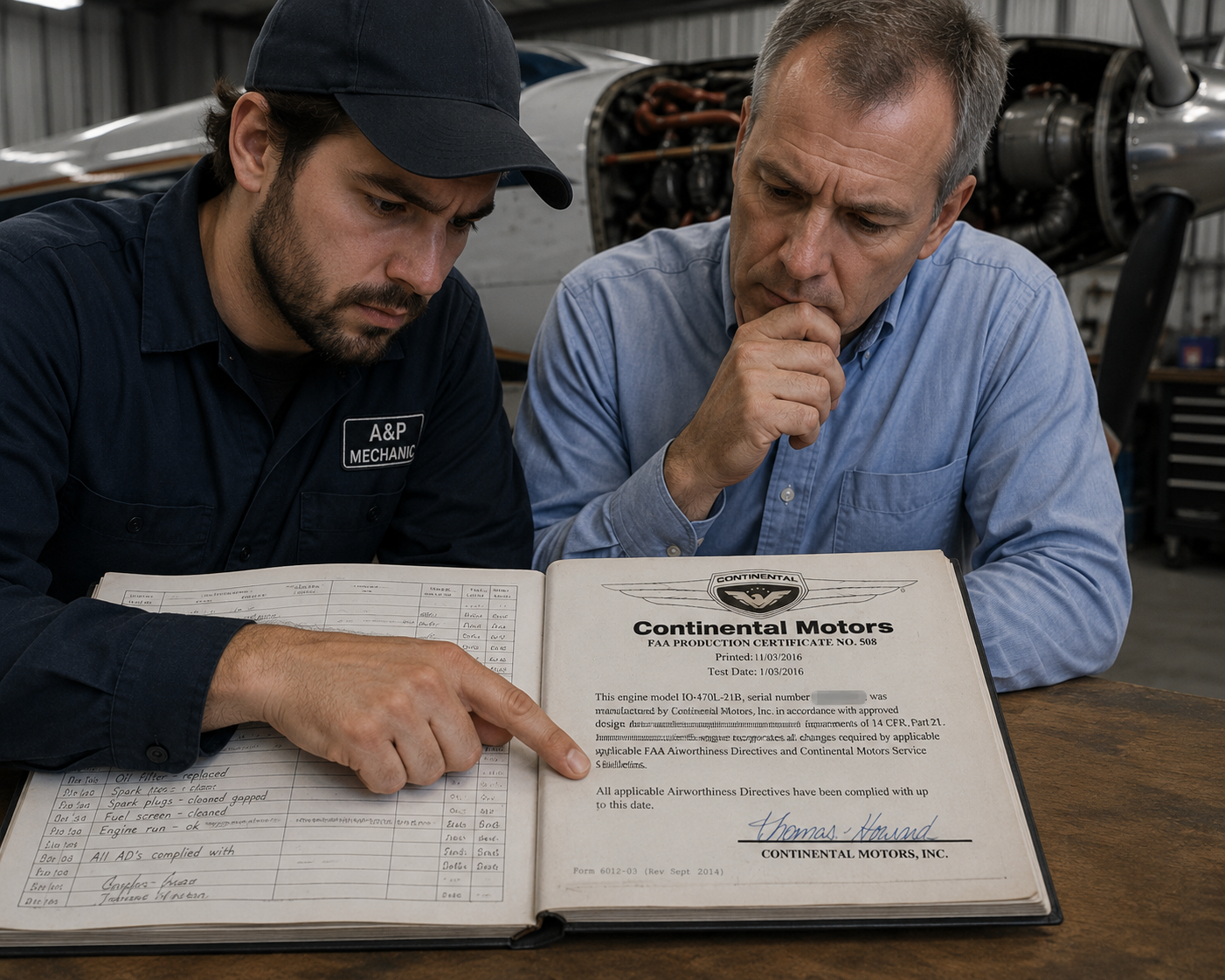

In this specific instance, the listener received the engine with a statement stating, “The approved design data for this engine incorporates all changes required by applicable FAA Airworthiness Directives and Service Bulletins.”
.png)
Without an AD/SB list backing this up, to us this reads a lot like the “All ADs complied with”. When we reached out to Continental about providing an AD/SB report or documentation with the certificate to back it up, and they said, “We used to do that back in the nineties. We don't do that any longer. Now we put a sticker on the inside of the logbook that states that all ADs and service bulletins have been complied with at time of build.”
“We used to do that back in the nineties. We don't do that any longer. Now we put a sticker on the inside of the logbook that states that all ADs and service bulletins have been complied with at time of build.”
Under Part 21, holders of a production certificate are required to maintain quality control systems that ensure certificated aircraft and engines not only work properly, but also conform to their type design and are in a condition for safe operation.
21.146: The holder of a production certificate shall—
(b) Maintain the quality system in compliance with the data and procedures approved for the production certificate;
(c) Ensure that each completed product or article for which a production certificate has been issued, including primary category aircraft assembled under a production certificate by another person from a kit provided by the holder of the production certificate, presented for airworthiness certification or approval conforms to its approved design and is in a condition for safe operation
In a perfect world, these checks (specifically addressed under 21.146) SHOULD ensure ADs are complied with properly; however, reports from the field suggest this has not always the case. Roxanne Rosado, A&P/IA at TBX told us, “Lots of OEMs miss ADs at delivery or SBs (specifically SBs). I've also seen where they label the AD as 'N/A' when it should have been signed off to begin with.”
While we expect most ADs (and service bulletins) related to engines to be “compliable” by the OEM, there are certain engine ADs that pre-date the manufacturing date applying to 3rd party appliances, fuel lines, fuel line clamps, magnetos, prop strikes—notwithstanding recurring ADs—that will ultimately be up to the owner/operator to comply with.
For example, the Lycoming fuel clamps AD (2015-19-07) – if you were to receive a Lycoming engine manufactured after 2016, you’d want to make sure your mechanic performing the install did NOT use plastic tie straps for the fuel lines. If you simply wrote “PCW” for that AD on the basis of the manufacturer’s note – you might get yourself into trouble.
As for recurring ADs, it is crucial that owners (and their mechanics) understand if (and how) they've been complied with, including next due requirements if not complied with by a terminating action.
Given the challenges in determining AD compliance, we recommend owners and operators perform an "AD audit" on all ADs (or SBs) prior to the date of manufacture to confirm compliance. This would simply be going beyond the token “PCW – see manufacturer’s production certificate” to include a little more teeth, i.e. “confirmed by visual inspection by so-and-so on this date.”
As we’ve noted in our piece, “Checklist for Life: 8 Rules Aviation Taught Me”, we believe a healthy amount of skepticism is helpful in staying one step ahead of a mistake. As we’ve articulated in "The Logbook Do’s & Dont’s", while it may fall on the OEM under Part 21 to have delivered an airworthy engine, mechanics should also note that accountability will also fall to them at inspection time, “where all applicable airworthiness requirements” must be met (43.15).

