

Our GA maintenance industry keeps aircraft flying, but it depends largely on a parts ecosystem that is becoming increasingly complex. Mechanics and maintenance shops are often the FIRST to experience the consequences of long lead times, discontinued components, pricing pressures, documentation challenges, and limited supplier options. Yet their perspective is rarely captured in a comprehensive, industry-wide way. Our "Parts Survey" was created to change that.
By gathering direct feedback from the professionals who source, install, and certify aircraft parts every day, we aimed to identify the industry's biggest pain points, emerging trends, and opportunities for improvement. We hope these results will provide valuable insight for aircraft owners, manufacturers, distributors, PMA suppliers, regulators, and trade associations to help inform practical solutions that strengthen the general aviation maintenance ecosystem for everyone. Read our summary below:
👉 Download the Summary: key findings and analysis in PDF format here.
👉 View the Full Survey Report: complete survey results, charts and data here.
Time has become general aviation's most valuable currency. Talk to any maintainer or owner in GA today and you'll hear about it: time looking up part numbers, time searching for parts, time spent working with a plane owner on available options, time haggling... all this time adds up, and much of it becomes a drag on shop utilization. As one respondent said, "We spend a crazy amount of time ordering parts: looking them up in the IPC, searching online, finding superseding numbers, emailing salvage yards, etc.”
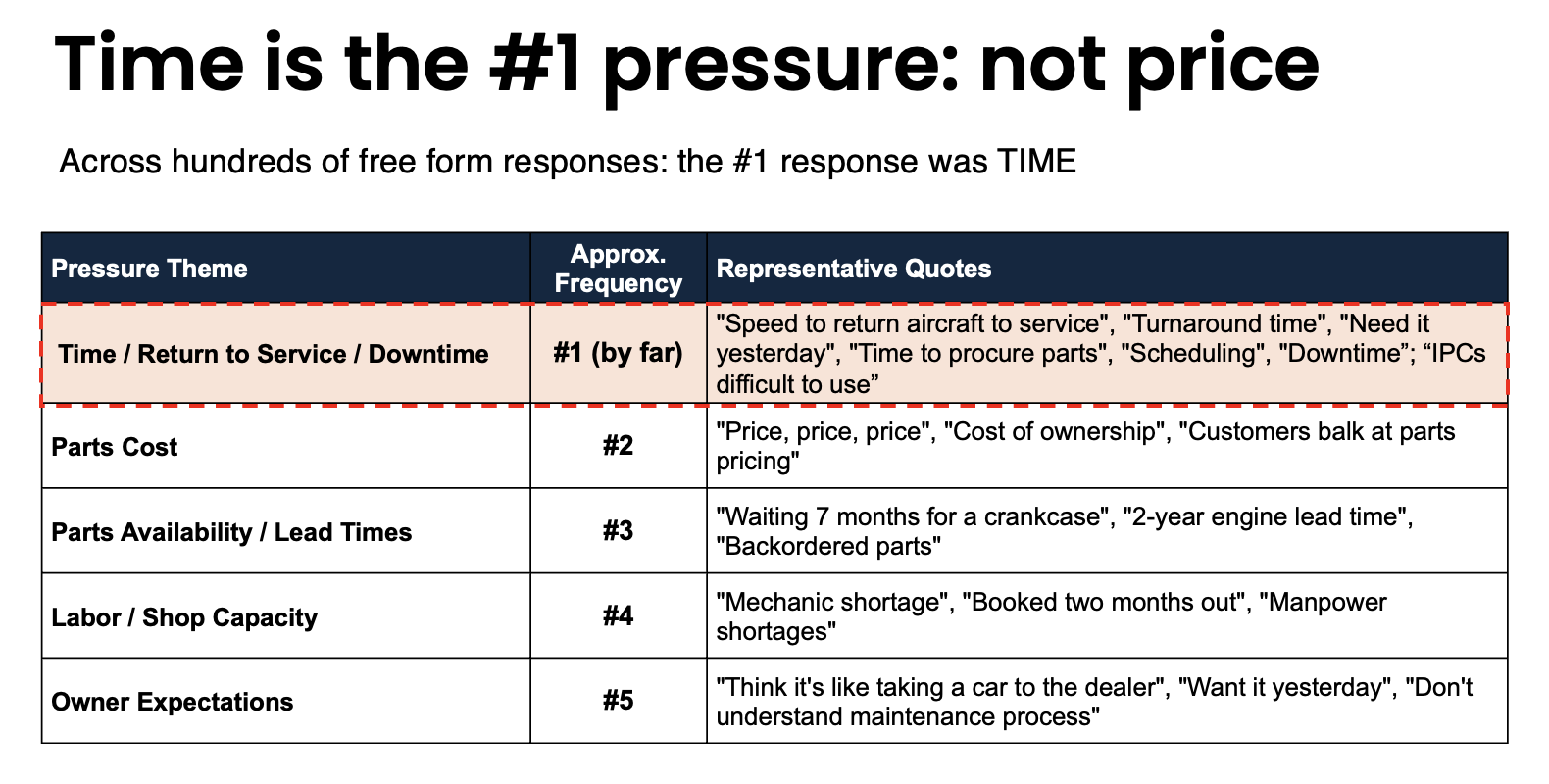
The second demand on time is scheduling, exacerbated by the difficulty in finding and retaining qualified A&Ps for GA maintenance shops (this was the #2 challenge in our Annual Survey). One responded said, "We are two weeks out for simple things like oil changes and over two months out for Annual inspections. Customers still think they can call on the 20th and we will get their annual done by the end of the month and then get upset when we tell them we can't even start it until two months later."
Finally, time managing the customer relationship is a significant time suck. One respondent said a significant challenge with owners today was they didn't understand what it takes to complete "a legal and quality repair," and that owners are "always looking for a cheaper way out." Another shop said, "We see the most pressure coming from customers with older aircraft, expecting the same bill they got 5 or 10 years ago."
When asked "How satisfied are you with your primary suppliers over the following attributes (parts availability, lead times, pricing, tech support, and shipping speed)?" Nearly three-quarters (72%) of respondents said they were dissatisfied with pricing and nearly two-thirds (59%) said they were dissatisfied with lead times.
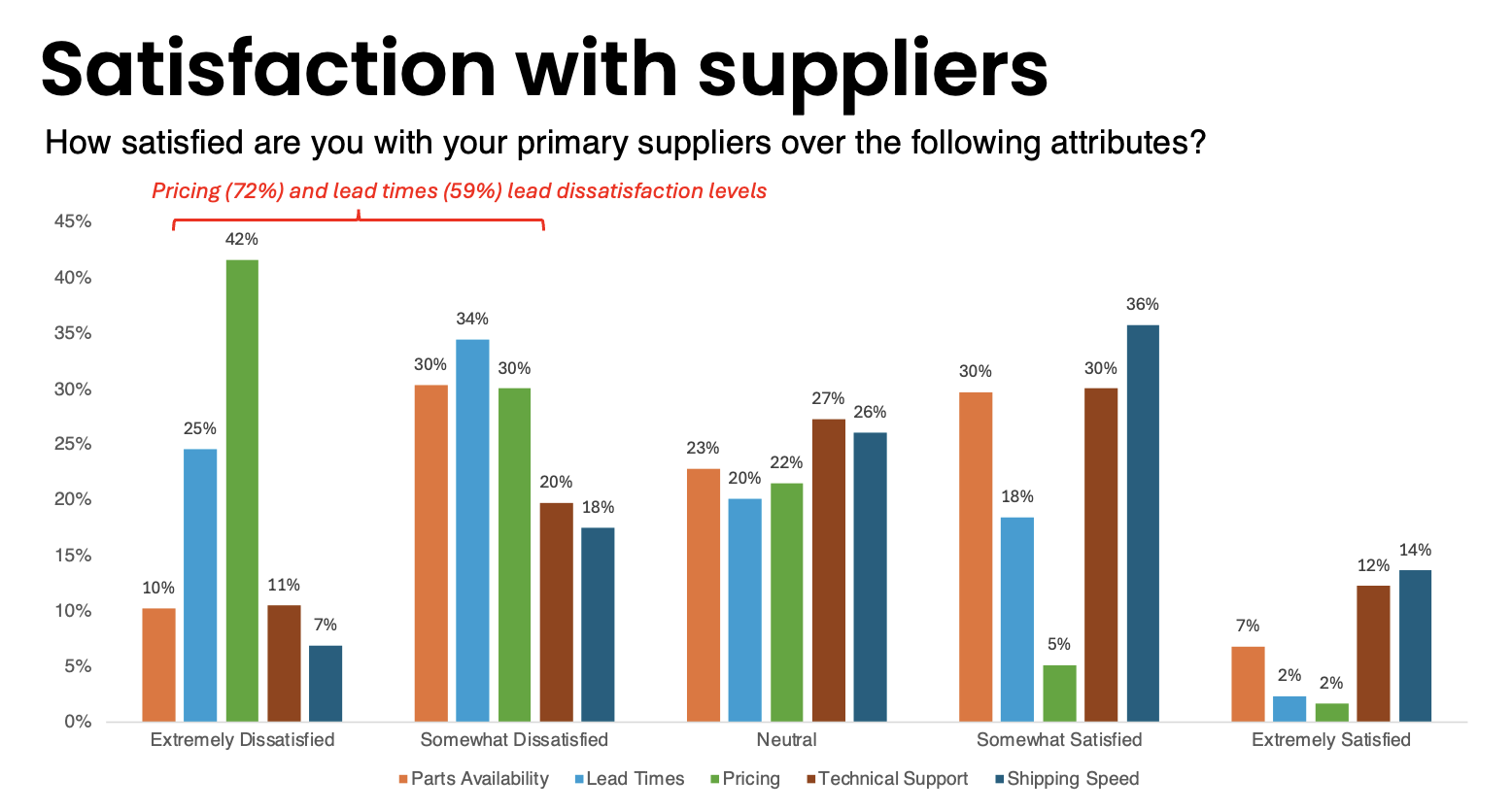
After several years of consolidation, the entire industry has seen 100-400% price increases across the board. This has been met with almost an antipathy towards any form of support. In fact, this survey will show that the market is not only struggling, but also sees further weakening for the foreseeable future. Unless these price changes and long lead times are met with an increase in supportability, we are concerned that operators will be forced to cut corners, undermining safety and eroding the safety gains we've made over the last 20 years.
Conventional wisdom would suggest the opposite: small GA shops (lacking a dedicated parts person and buying power) working on legacy aircraft should theoretically see more delays. WRONG. The big guys - large shops with dedicated parts personnel, accounts at all the leading distributors and OEMs, and substantial buying power, see the most delays. Why is this?
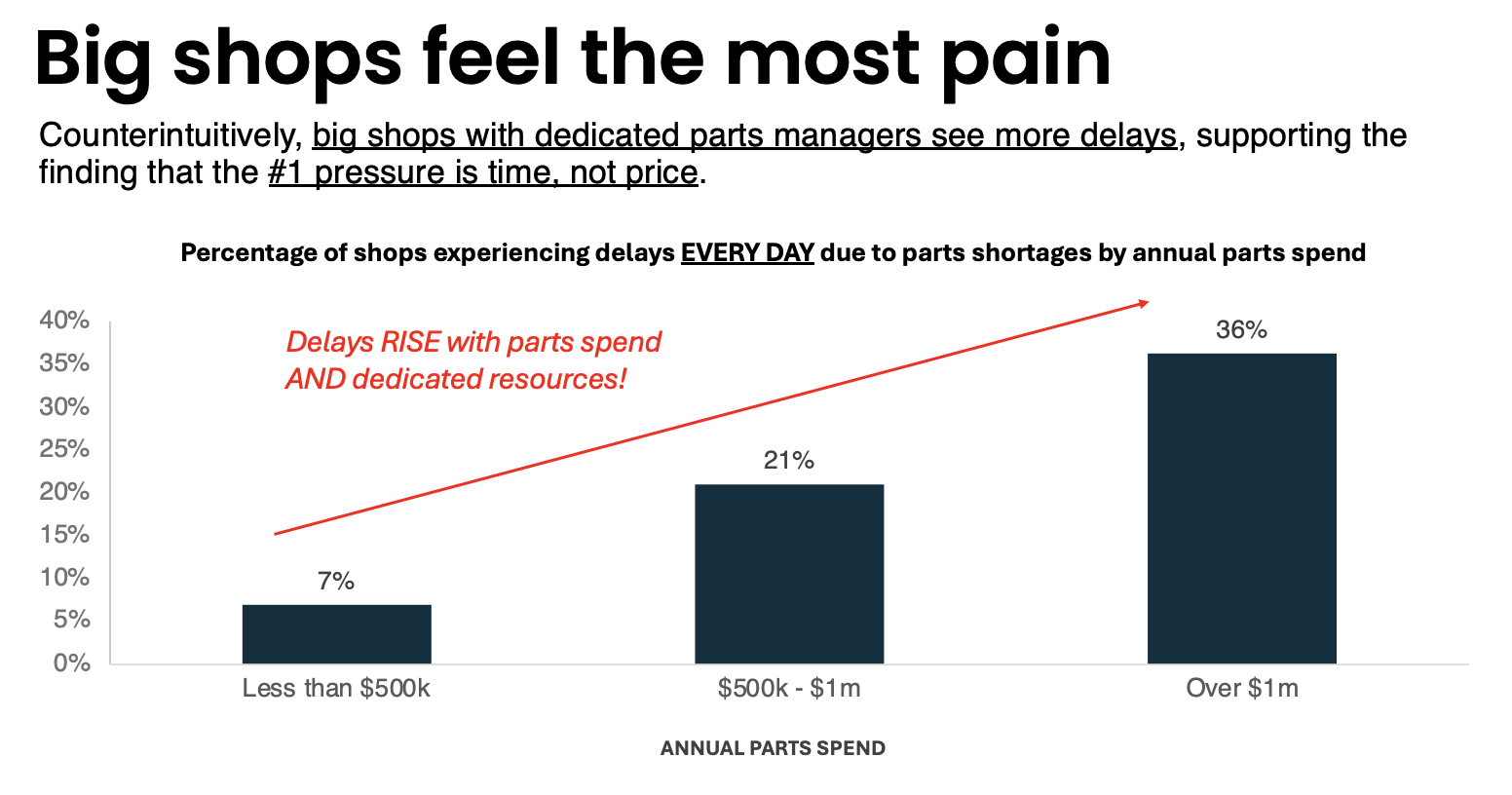
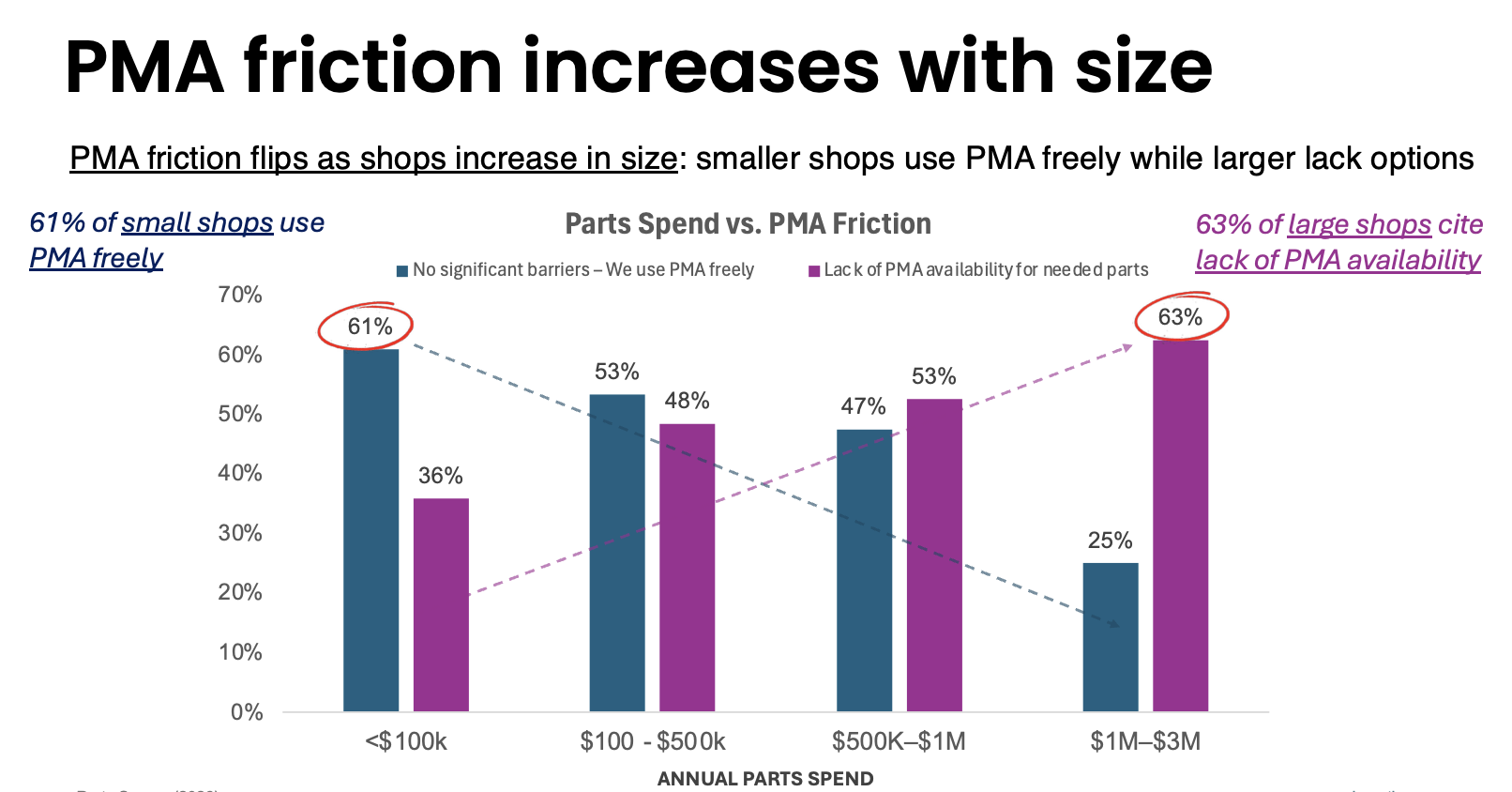
Well, for starters, larger shops, many of which work on Business Jets, aren't immune to parts and supply chain delays. Many of these (relatively) newer aircraft lack PMA alternatives, and OEMs have been struggling to keep up with the complexity of managing a large, distributed supply chain across dozens of variants, all with different demand profiles. The lack of data doesn't help: many OEMs are flying blind to what owner / operators are experiencing, while also focusing their resources on selling NEW aircraft vs. supporting existing owners ("the aftermarket").
When you are operating a flight school, charter, utility, or 135 operation, downtime is LOST REVENUE. For many of these operators, shopping around doesn't matter as much as lost flight hours, so they tend to focus on AVAILABILITY (i.e., "is the part in stock?") over price (i.e., "is this the cheapest part I can get?"). Bigger shops, as measured by dollar volume, by definition serve larger operators, including the business jet community. This is a community with a high propensity to pay, given the cost to own and operate business jets.
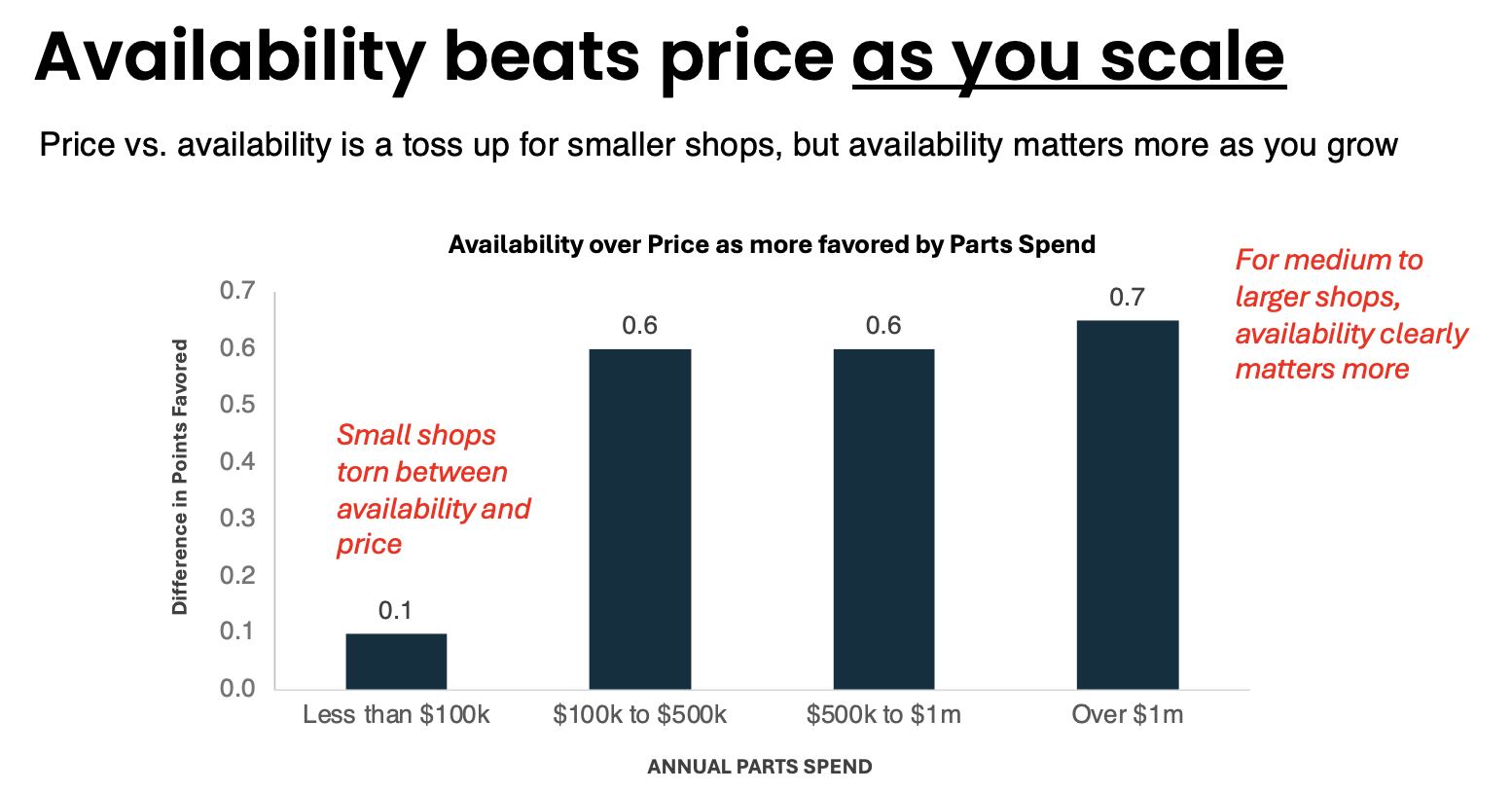
Smaller shops, on the other hand, deal with the single engine piston owner flying for pleasure, and these days, often cash-strapped. For these "traditional" owners, shops more and more have to show owners they have looked around enough to justify paying the price for parts (and labor) to do maintenance.
While this takeaway may seem "obvious", we've never seen the statistic as to when a maintenance shop starts to hire a dedicated resource to make ordering parts a full-time role within the organization. Typically, a dedicated resource, which requires budget and training, isn't brought on in a full-time capacity until a shop does over $1m in parts orders. At that level of "cost of goods sold" (COGS) you can imagine at least a 5-10% lift in productivity or margin to cover their wage expense.
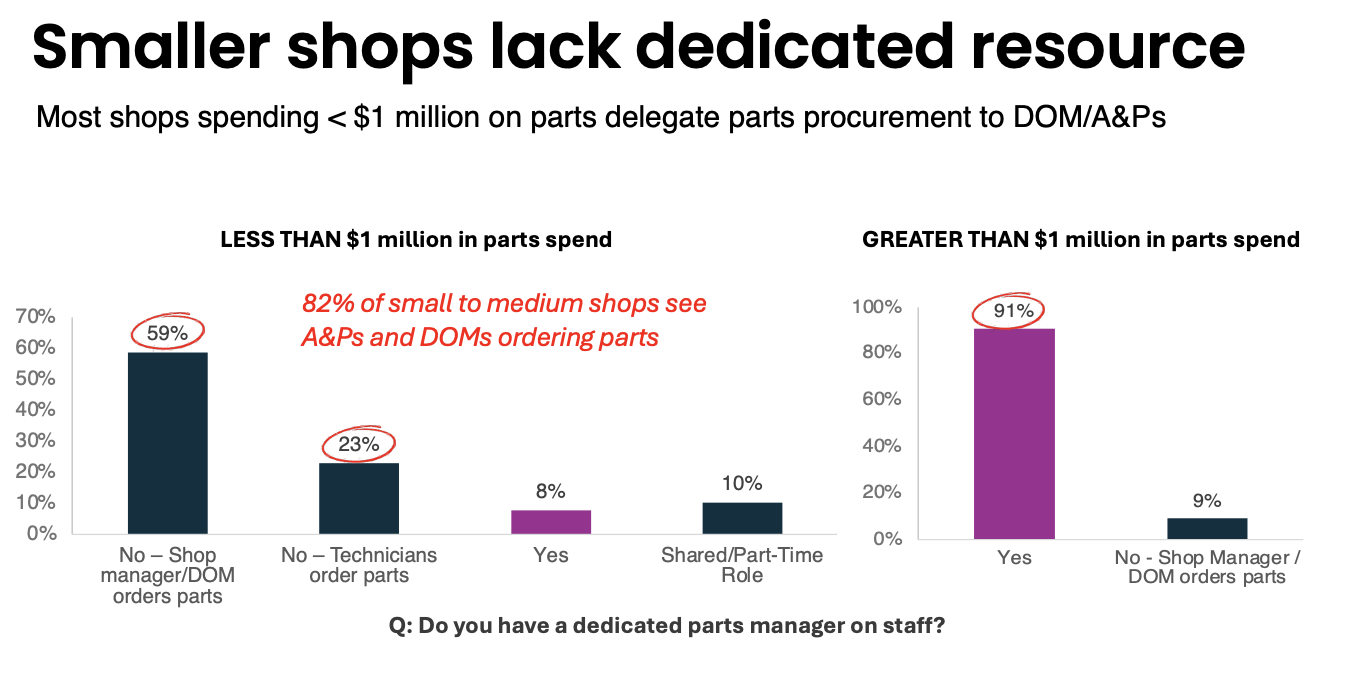
For us, what it speaks to is the need to simplify the ordering and procurement of parts as it is yet ANOTHER TASK that falls on the shoulders of A&P/IAs who are already too busy doing maintenance and completing inspections.
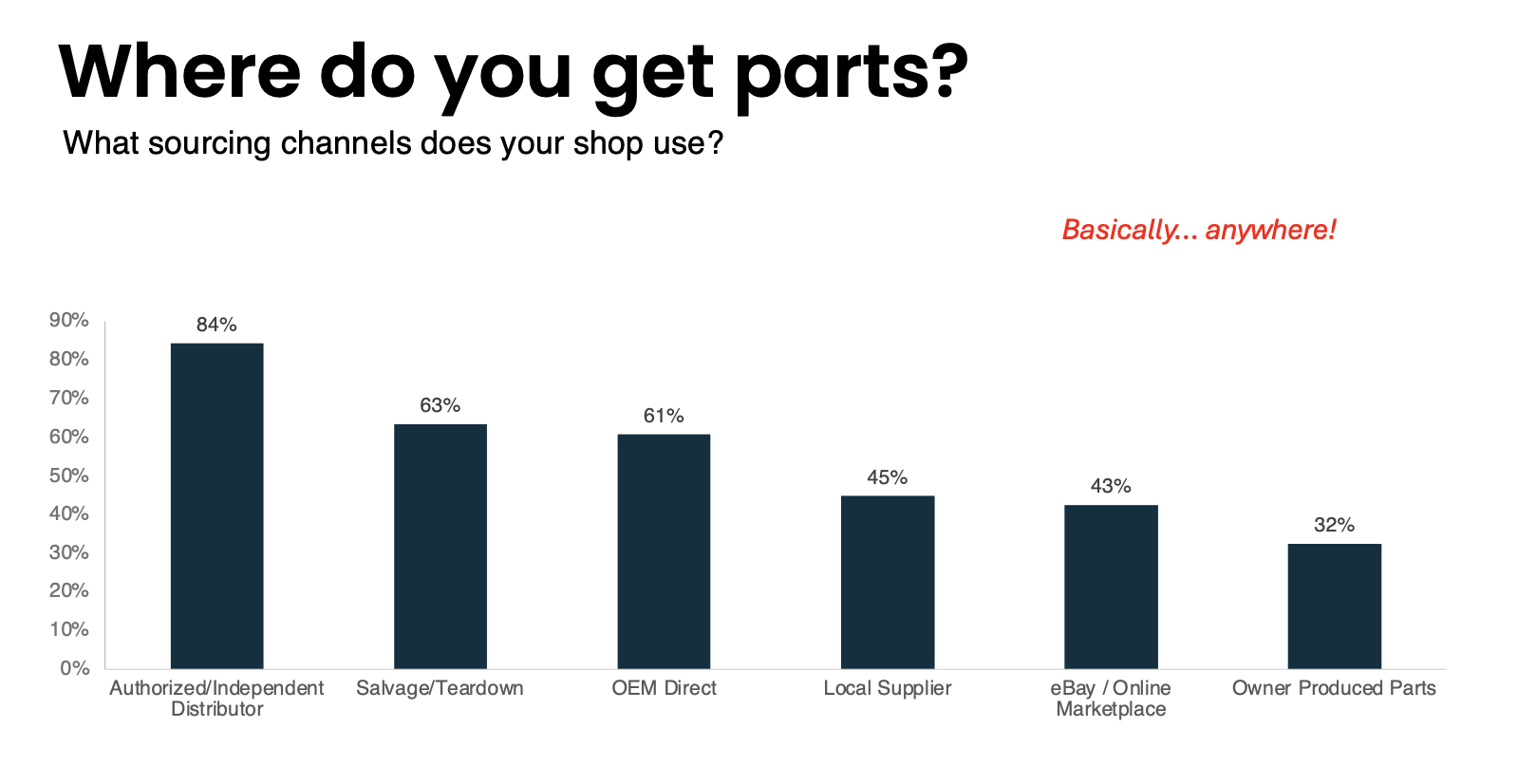
Building off the fact that smaller shops trade-off between price and availability, these shops often rely on a multi-threaded sourcing approach that encompasses PMA parts, salvage parts, and even owner-produced parts, due to a mix of small GA owner's price sensitivity and legacy aircraft sustainment issues.
On the legacy sustainment side, every OEM struggles with the challenge of building, selling, and supporting "on the run" aircraft while managing what's left of the complex sustainment supply chain for their legacy models. In many cases, many of their Tier I and II suppliers no longer exist, and parts diagrams don't exist in modern formats (such as CAD diagrams) to quickly find new suppliers. Adding to this complexity are declining flight hours and volumes, making it challenging to adequately source new suppliers for low-run production parts.
Owner operators are left with running the gamut of potential parts solutions: PMA options, which help plug the gap, and salvage parts, which can be extremely useful for legacy aircraft sustainment but are one-offs and require closer inspection in terms of life limits, serviceability, and proper supporting documentation. As one respondent told us, "We can normally find the parts we need, but it takes multiple sources and looking around.” Owners can (and do) resort to owner-produced parts, which in many cases can help fast-track maintenance for certain items, but also requires some forethought in terms of supportability over the long term.
As you go upmarket towards the turbine-world, you begin to see a falloff in PMA alternatives. Why is that, when we also found that turbine shops were very open to PMA alternatives, but cited lack of PMA alternatives as the #1 reason, among others (regulatory, contractual, etc.).
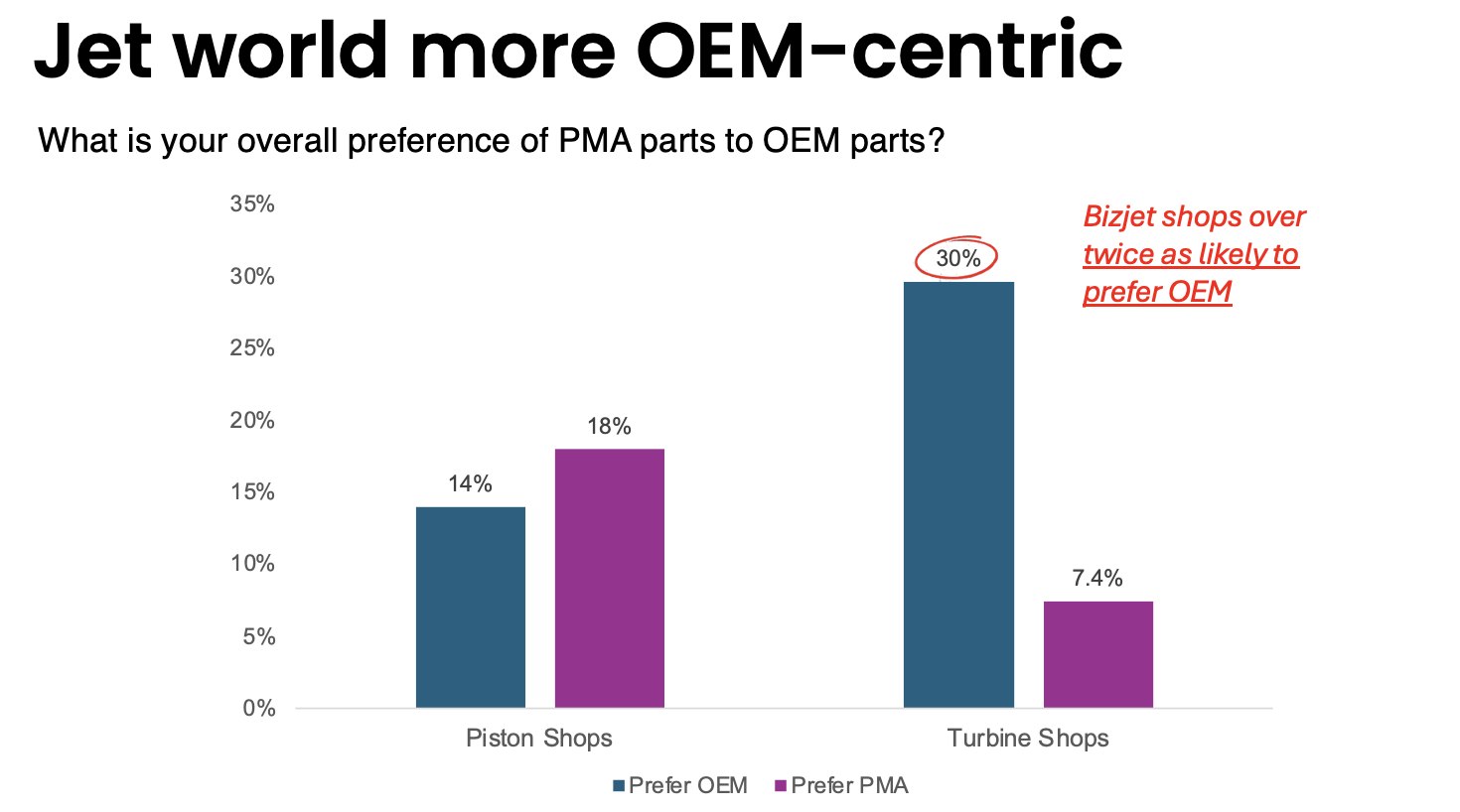
For starters, it can be difficult for PMA companies to justify the economics of designing, testing, and certifying the alternative when the fleet size for turbine is MUCH smaller than piston. Additionally, owner/operators of business jets are also up against strict OEM aftermarket programs designed to lock in future maintenance and parts, i.e. "power-by-the-hour", or JSSI-like programs. There is also a slight perception issue as it relates to the PMA vs. OEM debate and perceptions on re-sale value: often, owners may prefer to see the jet was serviced with parts directly from the OEM, boosting the resale value. We see this in the data on the perception of OEM vs. PMA, when measuring against type of maintenance shop (piston vs. turbine):
Survey respondents were given the opportunity to select aircraft components that were "seeing repeated failures". Exhaust system parts, avionics/electrical components, and engine components were the top three:
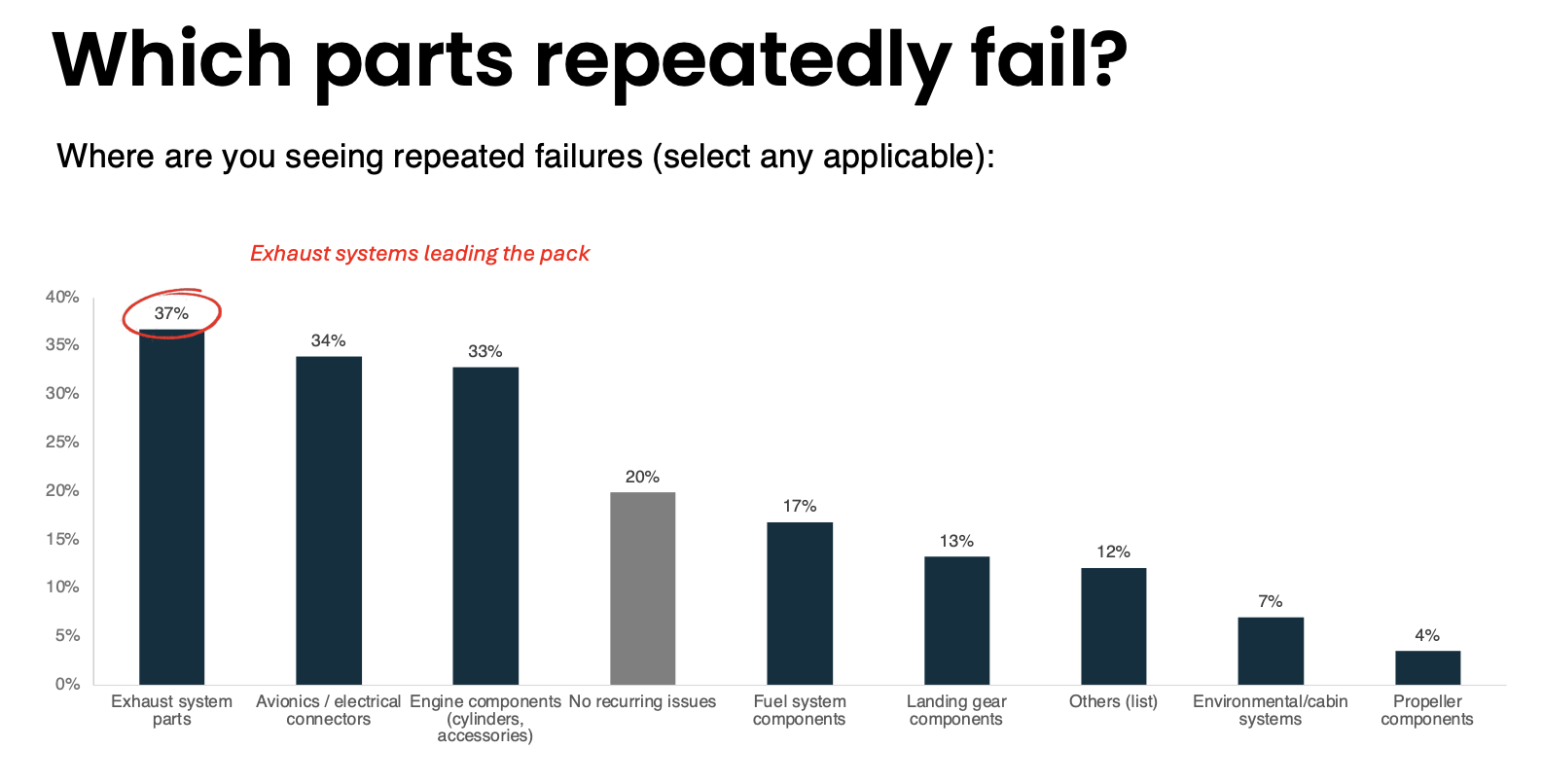
It bears noting that these three are common issues in GA aircraft: exhaust systems have seen repeated issues (we've written about the V-band clamp AD extensively here) and avionics / electrical components are complex and challenging on legacy aircraft. Engine components, particularly cylinders, were mentioned as another challenge, given the lack of support, alternatives, and long lead times (not to mention rising prices) facing GA operators today. “When the price of an overhauled engine is more than the aircraft it is going to be installed the eatery level aircraft will be scraped. Meaning fewer will be flying," said one respondent.
One question that repeatedly comes up at the local airshow and tradeshow is PMA vs. OEM perceptions on price, quality, and availability. Interestingly, the data suggests that the perception of PMA parts (as it related to OEM parts) EXCEEDS OEMs on availability and cost, meaning owner/operators expect PMA alternatives to be MORE IN STOCK and at a BETTER value than the OEM. As for quality, the 92% of the GA industry as a whole perceives PMA parts to either match or exceed OEMs on quality (!)
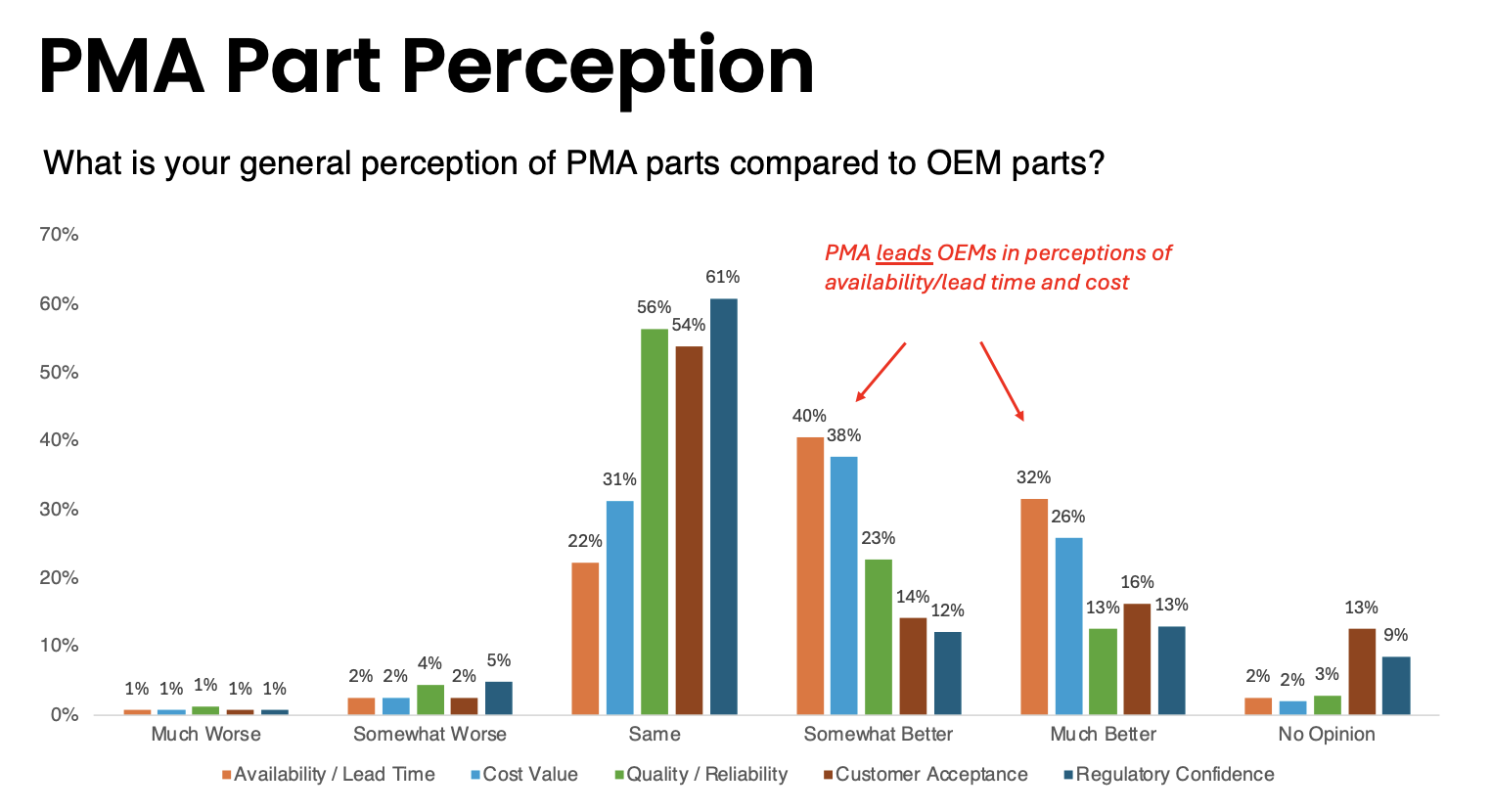
If that's the case, then why isn't everyone buying PMA parts? For starters, PMA alternatives do not exist for every part.
When asked on their overall view of the aviation part supply environment, 44% of respondents said they saw the environment "worsening slightly" and 22% said they saw the environment "worsening significantly". Only 15% saw the environment improving. These results do not inspire confidence.
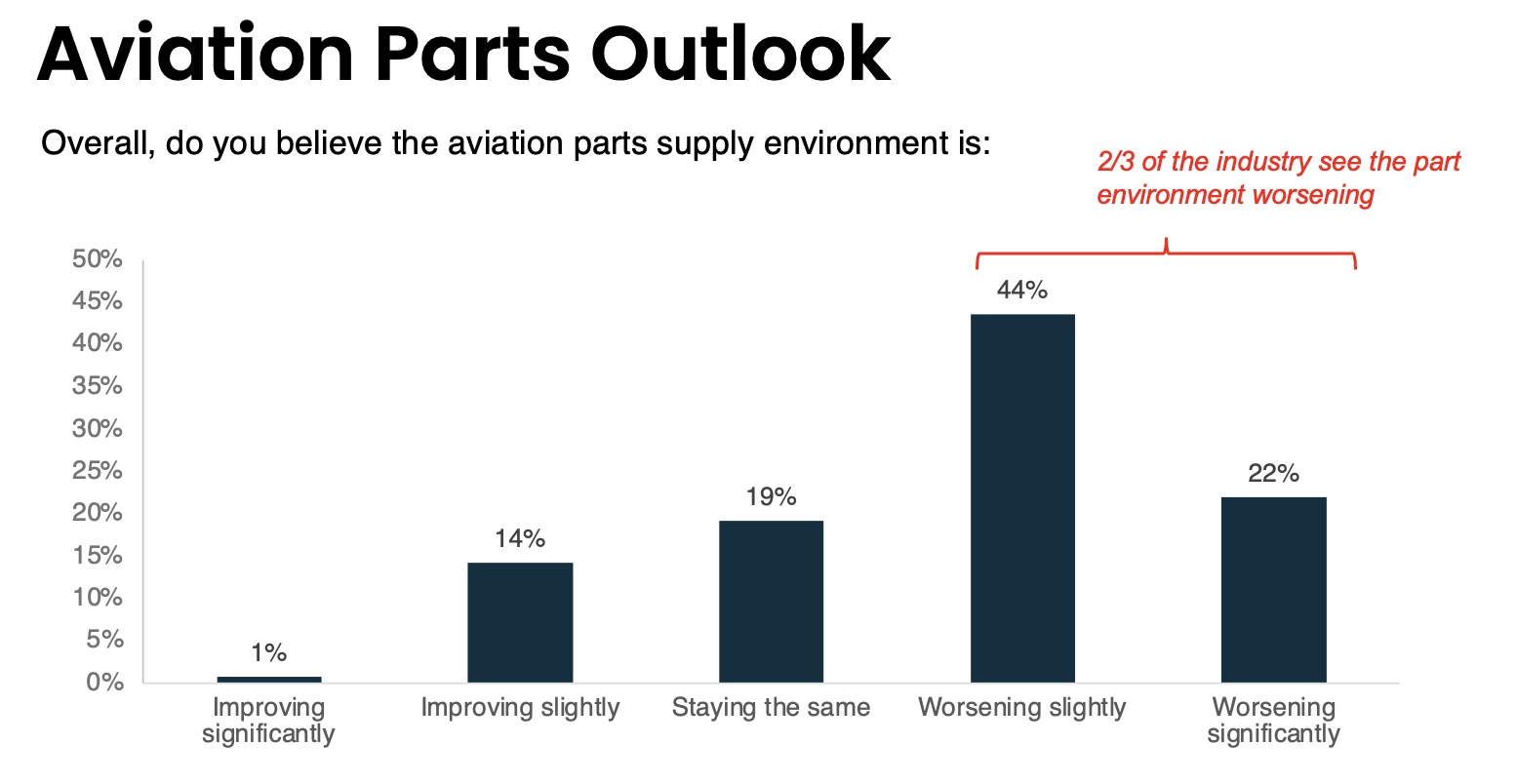
Why is everyone so negative? Responses ranged from rising prices, lack of availability, OEM supportability, quality issues, and even owner/operator expectations were mentioned. Mechanics are caught in the middle of GA's "Wall of Worry", where they are at the center of all of these challenges, and often don't receive any support (if at all) from other stakeholders. It's important to note that "rising prices" is only part of the problem - if rising prices were met with OEM and vendor support, the brunt on maintainers wouldn't be felt as hard as it is today. As one respondent said, "it’s hard to find parts for legacy aircraft when the manufacturer refuses to provide support and refuses to allow anyone else to repair a broken part."
Talk to any GA maintenance shop and you'll hear about how difficult it has become to order a part. One busy shop owner told us, "You'll have a number that just doesn't work anymore...then you find out what the new number is. But that may not be the number in the books at all." This is exacerbated when determining if a part# can work when looking at all available, superseded part #'s, and determining if that part is still "good", but as he said, "You got to figure that out. That right there wastes SO much time for these customers when we're having to spend hours on crap like that."
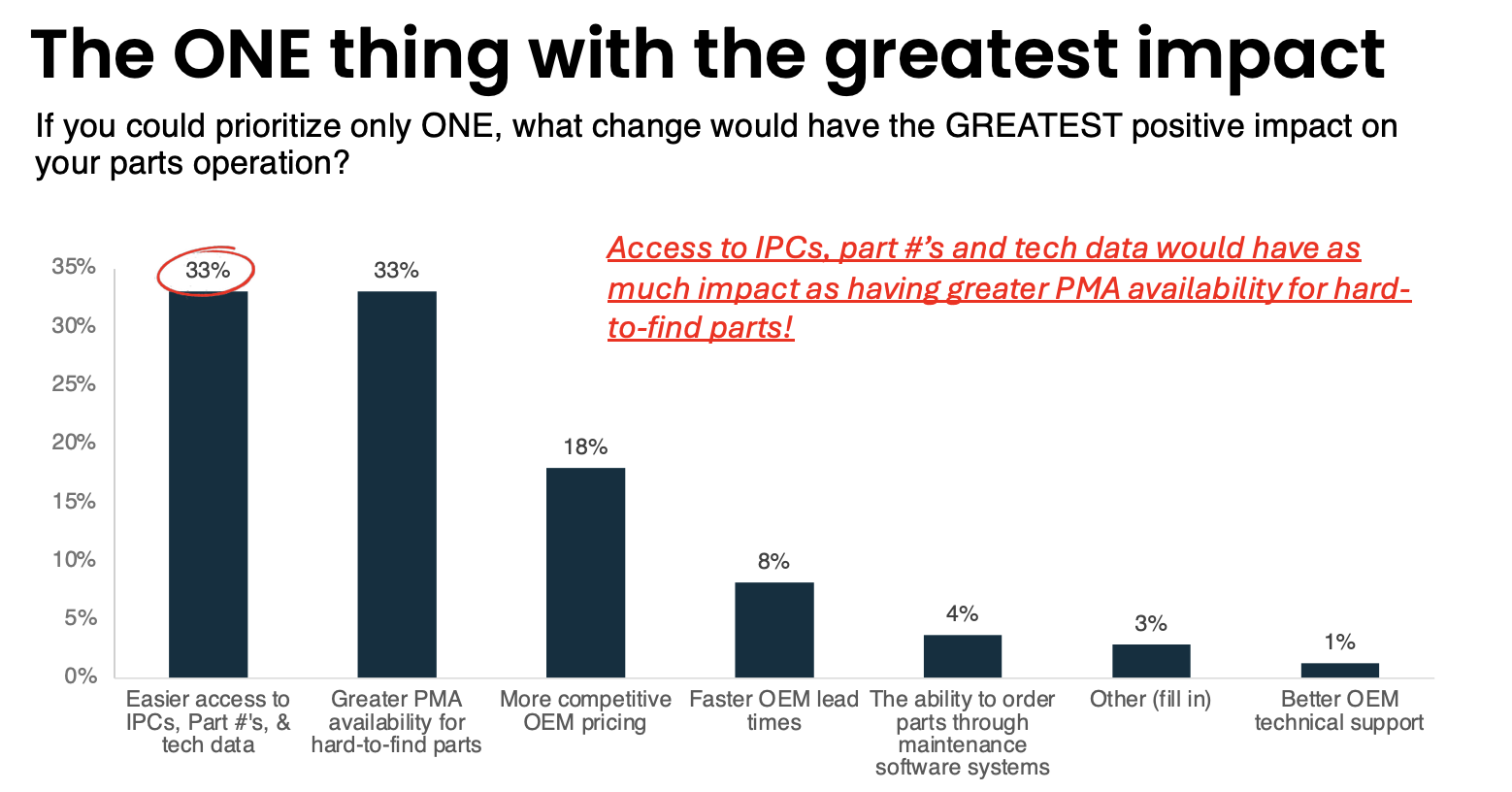
Given the intense amount of consolidation and changing of Tier 1 & 2 suppliers to OEMs over the last 5-10 years, OEMs should prioritize simplifying access to information that makes it EASY for customers to order parts. "With all of the private equity jerks taking over, they could at least simplify the searching for parts and the ordering of available parts," said one respondent. If it takes a day to determine the right part number, 3 days to wait for a response from the OEM, and then 2 days to work with an owner on understanding their options, how can owners expect a GA maintainer to turn around the plane in less than a 1-2 weeks?
👉 Download the Summary: key findings and analysis in PDF format here.
👉 View the Full Survey Report: complete survey results, charts and data here.
----
Interested in learning how our software tools power the General Aviation industry? Try our 10-day no-obligation free trial and see why a majority of GA shops prefer TBX as their system of record for tracking compliance and maintenance.

